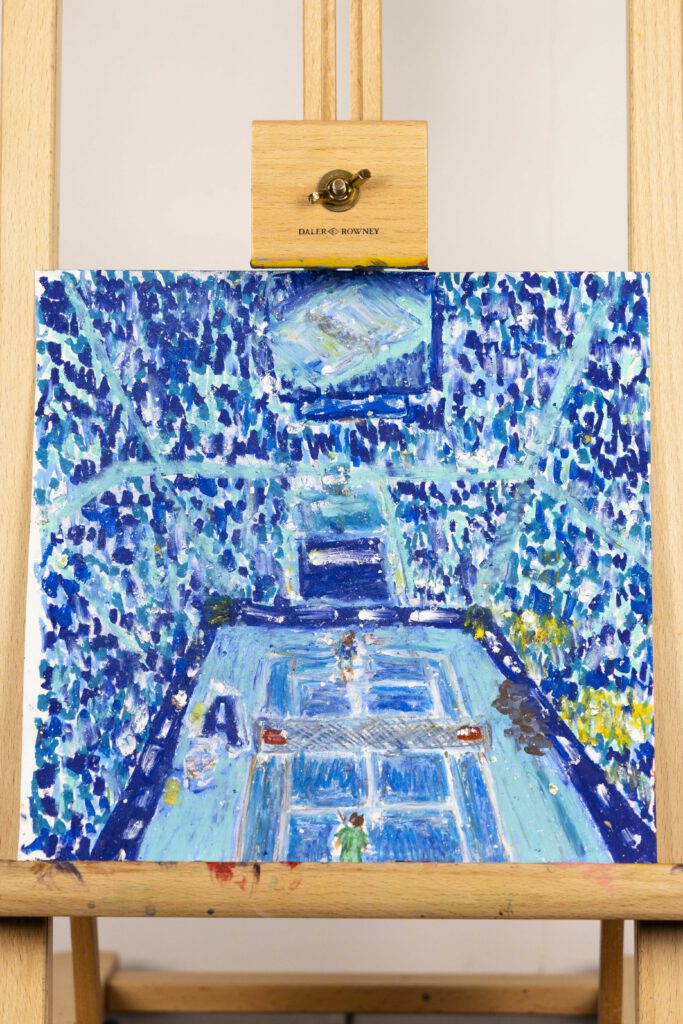
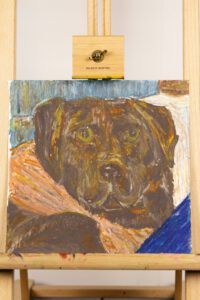
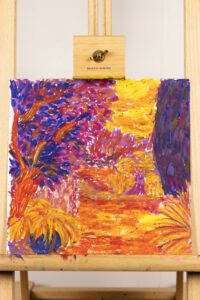
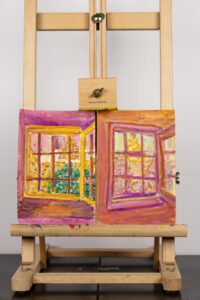
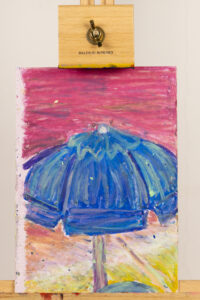
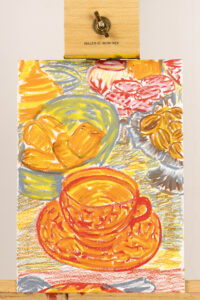
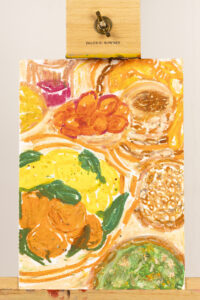
Color is the starting point in Francesca’s work. Free to express itself, it interprets a state of mind, an intimate and imagined reality, and reveals itself through an infinite number of chromatic combinations—vivid and always well contrasted. Only afterwards comes the drawing, almost always created from life, with swift strokes and precise lines.
Any object can become the subject of her drawing; there are no fixed criteria, nor hierarchies: a strawberry is as valuable as an ashtray, a chair as a bees’ nest, a mountain as a moon that lights up the night. Yet it would be wrong to think that chance guides her hand: what captures Francesca’s attention and intrigues her gaze is first imprinted in memory and only then transposed onto paper. Drawing becomes an act of liberation. Indeed, it is from apparent simplicity that the narration of a world made of everyday life begins; a reality that is always before our eyes, yet too often overlooked, is forcefully called back into focus. Objects and landscapes come alive and acquire their own capacity to exist, independently of their context. The result is a clear and pure language that avoids unnecessary superstructures, affirming instead an intimate and sincere awareness of reality. The delicate and spontaneous elegance of Francesca’s drawings—something far from obvious in contemporary art—reminds me of Wim Wenders’ beautiful film Perfect Days, where every simple action or single object becomes part of a perfection that reveals itself only when we allow ourselves to let go of the layers imposed by daily life and society. No technique could be more fitting for these works than pastel. Agile, quick, and easy to carry anywhere, it becomes a faithful companion to the urgency of expression and to the desire to capture color and life across small sketchbooks and scattered sheets of paper.